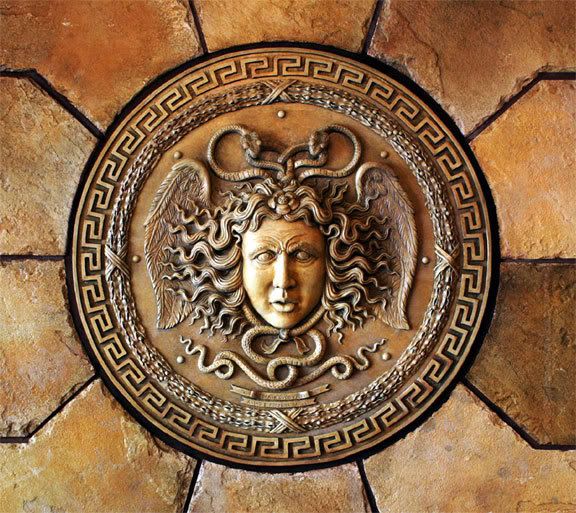
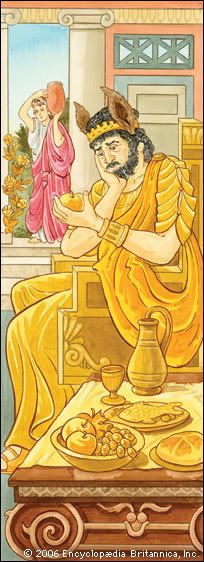
Alright, well this is Part 4, the last part of the series, continued from Part 3. Up until now I've basically been concentrating on mythological figures who are similar to Medusa, and trying to convince you that the reason for the similarities is that they all represent a similar archytype, whether or not the Greeks were even aware of it when they were carving Medusa heads into the pediments of their temples. Solon, the Greek sage, went to Egypt to question the priests in Egypt about the past. One day, as Solon discussed the history of the first man known on earth and the last flood, a wise old priest replied to Solon:
Solon you Greeks are mentally like children Is there not an aged sage among you ? You all too young in spirit and have no ideas handed down from ancient traditions, no knowledge from ancient times. Many disasters have befallen humanity and many more will do so, the worst from water and fire, and the least by asteroids and meteorites, which spin around the sky and the earth.Egypt had a fairly stable civilization for quite a while, and were still able to remember most of their past. As a result, they were aware of where their myths came from and what they originally meant. The Greeks, however, lived in a part of the world which was frequently overcome with war and cataclysm. Therefore the Greeks had no idea where their myths came from and focused on only the exoteric stories. As Medusaesque deities can be found around the world, I believe that they represent a real event, and later a more sublime symbol, recorded around the world as an anthropomorphized figure. There was almost certainly another more esoteric level of meaning attatched to whatever event this new figure now represented (which I touched on in Part 1). Then a third level of meaning, which was just the soap-opera acts of the gods, which is what the Greeks focused on.
Every time you (Greeks) or other nations start to write and gather together the first rudiments of civilization, the furies of the sky crash down on you. The only ones who escape are the illiterate and the ignorant. So you must relearn everything whilst forgetting your past completely!
So, if the Egyptians had the older religion compared to the Greeks, where is Medusa in Egypt? Well, probably split into several different deities, as their religion is older and more refined, with specialized gods and their specific aspects. The Greeks probably combined a few mythological figures into Medusa from memory. In Egypt, there's the snake headed goddess Kauket "who ruled over the darkness with her husband. Her name also meant darkness, as did her husband's name, but with a feminine ending." If the Egyptians weren't obsessed with duality, they may have combined Kek and Kauket into one he-she like Medusa and Tlaltecuhtli. She was called "the bringer of night." There may be some connection to Medusa from the Egyptan Mafdet, the "slayer of serpents." She is actually a feline goddess (as well as a mongoose) because cats, and leopards, killed snakes and scorpions. Her hair was braided to reflect the sectioned body of a scorpion, and the braids ended in scorpion tails. She also wore a headress of snakes. And incase that wasn't enough, there's even mention of her ripping out the hearts of wrong-doers. Now it may seem contradictory for me to try and connect a feline snake-killing goddess with Medusa if it wasn't for Medusa being represented with her own leopards in the Corfu Pediment.
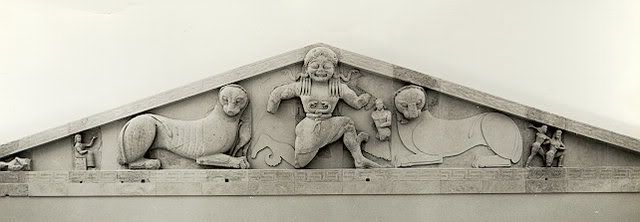
There is the scorpion goddess, Serqet, who "could punish those with the poison of a scorpion or snake, causing breathlessness and death, or she could protect against the same venom. Yet just as she could kill, she was thought to give breath to the justified dead, helping them be reborn in the afterlife." This is similar to the blood taken from Medusa's left side which was a poison, and from the right side which could bring the dead back to life. And we have the cobra goddess Wadjet who took the form of a lioness. Moving on, there is the moon god (male) Khonsu, associated with knowledge and time; and as such often represented along with the ever present Thoth. Khonsu "appears in the well known 'Cannibal Hymn' (Utt. 173-4) as a bloodthirsty deity who assists the deceased king in catching and slaying those gods that the king 'feeds upon' in order to absorb their strength. Specifically, it refers to him as 'Khonsu who slew the lords, who strangles them for the King, and extracts for him what is in their bodies.' Though only mentioned once in the Pyramid Texts, he is also referred to in Spell 258 of the Coffin Texts, where he is 'Khonsu who lives on hearts'." Like Medusa with her wings, Khonsu, as a sky deity is sometimes shown with the head of a falcon, though differentiated from Horus by the crescent moon (similar to Kali) on his head. And finally there is Apep, the great serpent, the Destroyer; patron of evil and darkness. Apep is of course way more powerful than Medusa, but I still see a similarity as Apep attacks the sun boat of Ra, and when successful, the world would be plunged into total darkness - a solar eclipse.

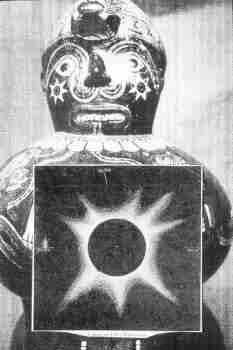
I believe that Medusa represents the moon, but more specifically, the moon during an eclispe; along with whatever feelings that event must have aroused in early man, and the resulting spiritual symbolism encoded therein. I think that the way Mesusa or other figures were represented might give us some clues at to whether this is true or not. Going back to Aztec mythology, we have the moon goddess Coyolxauhqui (pictured above as a serpent). "She was a powerful magician and led her siblings in an attack on their mother, Coatlicue, because she became pregnant in a shameful way (by a ball of feathers). Coatlicue's fetus, Huitzilopochtli, sprang from her womb in full war armour and killed Coyolxauhqui, along with many of the brothers and sisters. He cut off her limbs, then tossed her head into the sky where it became the moon, so that his mother would be comforted in seeing her daughter in the sky every night." Medusa became pregnant in a shameful way (like Coatlicue)and was beheaded (like Coyolxauhqui). Coyolxauhqui lost her head which became the moon, and Medusa is basically just a head, which happens to be depicted in the same way as other solar/lunar deities. "A shield-shaped stone frieze reflecting this story was found at the base of the stairs on the Templo Mayor. In this frieze, Coyolxauhqui is shown spread out on her side, with her head, arms and legs chopped away from her body. ... Scholars also believe that the decapitation and destruction of Coyolxauhqui is reflected in the pattern of warrior ritual sacrifice. First, captive's hearts were cut out, then they were decapitated, their limbs chopped off, and finally their bodies were cast from the temple, to lie, perhaps, on the great Coyolxauhqui stone." Again we have the blood or heart sacrifice theme. Medusa was never appeased with bloody hearts, only decapitated, but as I've already stated, I think the mythology surrounding her may be incomplete due to the lack of historical knowledge by the Greeks.
Here is the stone frieze of Coyolxauhqui compared to the Corfu Pediment. Notice the limbs are in similar poses. I think that the "rotation" depicted by the arms and the legs represents a rotating disc in the sky, a wheel that is turning, similar to the swastica symbol as a symbol for the sun or the movement of the heavens.

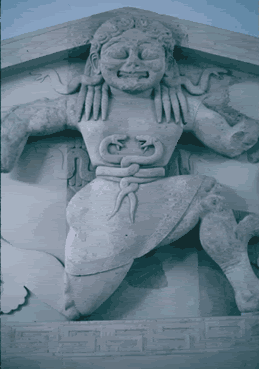
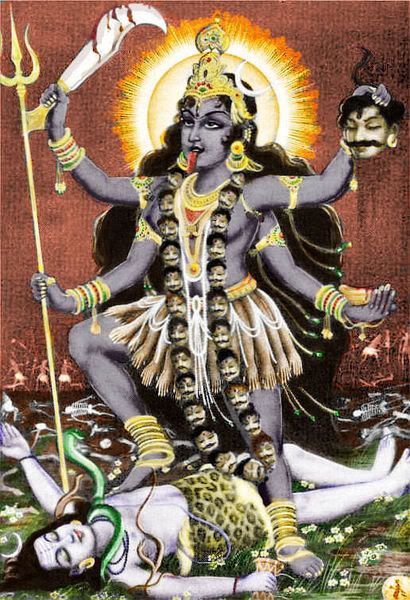
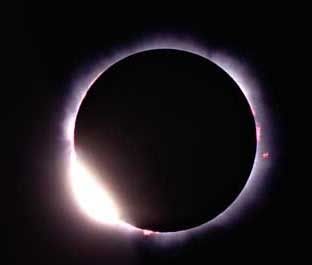
The arms and legs appear to be rotating in opposite directions, possibly representing two different things (sun and moon?). Medusa and Coyolxauhqui are oddly reminicent of the female vampires of the Phillipines, those night-time bloodsuckers, the Visayan manananggal ("self-segmenters") who would detach their upper bodies and fly through the night looking for victims. Infact looking at the picture at the top of this page, it's hard not to see Medusa as a vampire, at least all her counterparts seem to have a blood lust. Perhaps there's some parallel with Lillith, the disgraced first wife of Adam, and original vampire/succubus? The Corfu Pediment is a depiction of Medusa already having been decapitated, while it might not look it, her children who sprang from her neck wound are seen with her - either an indication of her death, or a continuity error. There's the winged horse Pegasus (missing due to damage to the sculpture) and the boy Chrysaor "Golden Sword." Not wanting to get into the mythology of Medusa's offspring, but as a small sidetrack, perhaps the "golden sword" which sprang from Medusas severed head is the first ray of light which is seen when a solar eclipse is ending.
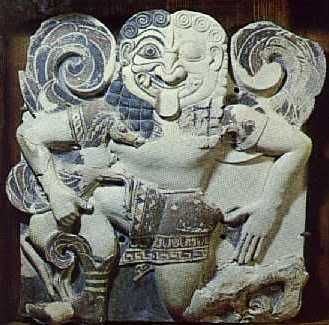
Keeping with the symbolism of the bent-limb, there is another more telling sculpture of Medusa (holding Pegasus), shown with 3 limbs bent in the same direction, and we can more clearly see her wings which remind us that she belongs up there.
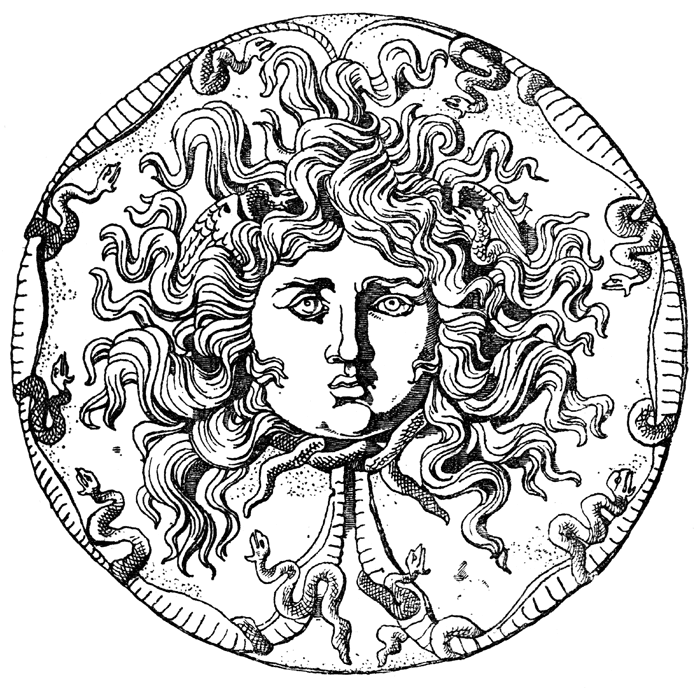
The moon makes 12 and a third lunations, or lunar months, a year. It takes three years for the moon to make a complete number of lunations (37), and as a result the number three is associated with the moon. Also the "triple goddess" of the moon is a familiar theme, as the moon has three phases, the waxing, full and waning. Note that there were three Gorgons, and many times there are three witches in mythology (like the Graeae), and in books and movies. (The Graeae were known as the Stygian Witches, no wonder I like writing about their conterparts the Gorgons. The Graeae, like the Gorgons, had one eye and one tooth among them (thanks Adam*), and were the offspring of the "old man of the sea.") Notice in the pictures below, Medusa ringed with serpents, and the moon's cycle depicted as a serpent. Infact in the Medusa picture, the serpent splits the circle into two halves with Medusa's head in the center, possibly indicating a waxing, full, and waning motif.

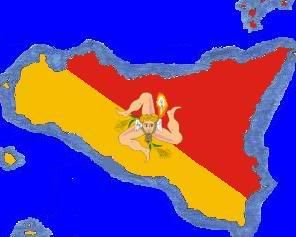
Medusa can even be seen as the now extremely interesting Trinacria. The trinacria is an ancient symbol and name for Sicily; due apparently to the triangular shape of the island.

My art history teacher said that Medusa was depicted with bent limbs on the Corfu pediment because the artists couldn't fit her standing because she was too big. How this makes sense I don't know. If they wanted her to fit, they would have made her smaller. She is constantly depicted in the squatting-running fashion for a reason. Even if the artists were so inept as to not be able to fit her in the Corfu pediment, it doesn't explain why in other sculptures she remains in a bent-limb pose. No, there is some reason, possibly unknown even to the Greeks, that she had to be shown in that pose. The Aztec deities I've presented were also shown in bent-limb poses, but it was probably because of their connection to childbirth. Medusa, like the moon, is male and female. She is basically a head with a body later thought up for her to fill in the blanks of her mythology. Something about seeing her paralyzes people with fear - turns them to stone. People cannot look at her directly, as we are all told to avoid direct eye contact with an eclispe. But what of the serpents? Why always at least two snakes beside her head? Well, I think that they represent the serpent-path of the eclispe. The invisible path in the sky which swollows the sun every now and again (shown above as the lunation cycle), when Apep temporarily overcomes Ra's sun-boat. Medusa has a relationship with Poseiden as well, linking her to the chaotic waters out of which, in some versions, her children are born from her blood falling into the water.
Apep, "water snake-demon of chaos," was a demon of the underworld, in the form of a giant water snake. It was believed that he was created when Nit spat into the primeval waters of Nun. He was the enemy of the sun god, trying to stop him as he travelled on his barque through the underworld each night. He was so powerful that little could defeat him, and even then, he was back again the following evening to threaten Ra. He was a demon outside of ma'at, the opposite of order, a demon of darkness and chaos.
Apep was never worshiped, but the ancient Egyptians protected themselves against him - he was a threat not only against people and the gods, but against ma'at and creation itself. As a demon of the unknown and related to frightening events such as unexplained darkness (solar eclipses were interpreted as a victory of Apep over Ra as he swallowed the solar barque), rituals were followed to ensure he could do no harm. In this, he was linked to Set, who also had eclipses, thunderstorms and earthquakes attributed to him.

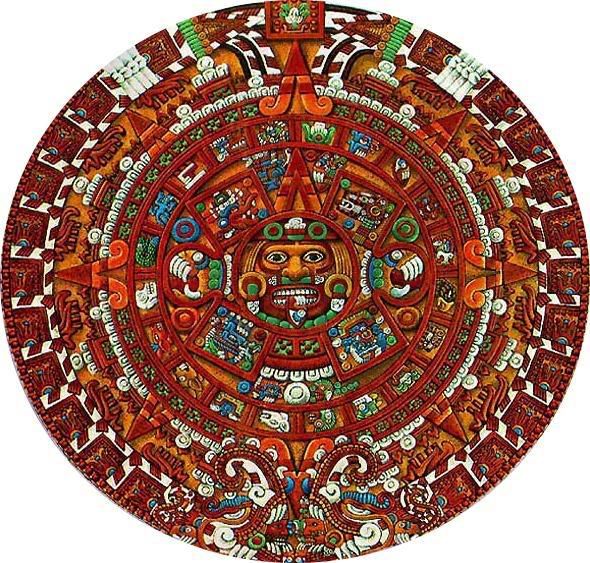
The eight pages of the Moon table of the Dresden Codex are a chain of numbers across the bottom line of each page translates into a time packet of lunar synodic intervals. There are clumpings of six lunar synodic months (178 days) followed by one set of five (148 days). Each bunch of five moons is followed by a picture. A close look at all of the pictures together gives very strong clues about what the Mayas would do, parcel out a chain of 405 full moons over more than three decades. The answer is that Mayan astronomers were attempting, apparently quite successfully, to predict eclipses. Some of these illustrations depict half-light, half-dark disks with lunar crescents opposing the kin glyph, symbol of the Sun ( kin means sun and day as well as time in the Mayan language). A serpent devouring the Sun and a dead lunar goddess hanging by her hair from a segmented serpent who represents the sky also appear in the pictorial portion of the table.Stonehenge is quite the famous astronomical clock:
Every year on the first day of summer, the Sun rises at a point that is farther north than on any other day of the year. At the ruins of Stonehenge in England, this solstice sunrise appears on the horizon in direct alignment with the massive heel stone. This is the most outstanding feature of this ancient monument, built during the same era as the Great Pyramid of Egypt. There is little doubt that the builders of Stonehenge used it to mark this special day as the beginning of each year. By counting the number of days between these annual alignments, they could determine the length of the year. This could serve as a practical calendar to mark holidays and seasonal festivals and to ensure the timely planting and harvesting of crops.But to predict eclipses, knowledge of two other cycles is required. One of these -- the length of the lunar month -- is easily determined. It is simply the number of days between one full Moon and the next. This cycle of 29-1/2 days is marked at Stonehenge by two rings of 29 and 30 holes, which together average 29-1/2. The other cycle, however, is of an altogether different character: it is a cycle of rotation of two invisible points in space (the two serpents always beside Medusa?). The evidence shows that the builders of Stonehenge probably discovered this cycle and could have used it to predict eclipses.
British antiquarian Dr. William Stukeley, who in 1740 was the first to note the summer solstice alignment at Stonehenge, advanced the notion that the monument was built by Druids to worship the serpent. He claimed that Stonehenge and similar stone circles had been serpent temples, which he called "Dracontia." Could this serpent symbolism be related to eclipses? Recall that the key to eclipses is the position of the lunar nodes. The length of time for the Moon to return to a node (about 27.2 days) astronomers call the draconic month. (Draco is the Latin word for "serpent" or "dragon.) Perhaps the mythical serpents of Stonehenge and the legendary dragon that eats the Sun are symbols of the same thing: the invisible presence in time and space that eclipses the Sun and the Moon.
This is, I believe, the first attribute which can be associated with Medusa - the frightening aspect of the moon during an eclipse. However once everyone was quite aware of the possibility of an eclipe it woud have become less worysome. It was then they higher ideas could be fitted to the already existing symbolism. To the Greeks, Medusa-Eclispe was probably just a boogyman bedtime story for all we know. Clearly the other figures with their blood lusts and connection to death would have been representations of the unkown, death, and nightime (relating to vampiric activity perhaps). And maybe it's because I've been reading about alchemy lately, but I think there is some important idea behind the power of Medusa to turn a person into Stone. First of all, this is quite reminicent of Lot's wife being turned into a pillar of Salt when she looked at Gods destruction of Soddom and Gommorrah.
Genesis 19:23To look upon it would instantly change you into Stone or Salt, similar to Midas and his touch, as I've said in Part 1 of this series. I'm being reminded also of that old Batman episode (the series with Adam West), where one of the arch-villans (the Joker or Penguin?) invents a gun which vaporizes all the water in a persons body, reducing them to a small pile of salt. Interestingly this device is in the most recent Batman movie where the Scarecrow uses it to vaporize Gotham's waer supply to activate his hallucinogenic chemical.
"The sun was risen upon the earth when Lot entered into Zoar. (24) Then the LORD rained upon Sodom and upon Gomorrah brimstone and fire from the LORD out of heaven; (25) And he overthrew those cities, and all the plain, and all the inhabitants of the cities, and that which grew upon the ground. (26) But his wife looked back from behind him, and she became a pillar of salt."
Luke 17:28-33
"Likewise also as it was in the days of Lot; they did eat, they drank, they bought, they sold, they planted, they builded; (29) But the same day that Lot went out of Sodom it rained fire and brimstone from heaven, and destroyed them all. (30) Even thus shall it be in the day when the Son of man is revealed. (31) In that day, he which shall be upon the housetop, and his stuff in the house, let him not come down to take it away: and he that is in the field, let him likewise not return back. (32) Remember Lot's wife. (33)Whosoever shall seek to save his life shall lose it; and whosoever shall lose his life shall preserve it."
The first phase of alchemy is called Nigredo, the Black Phase, and is represented as Philospher's Lead, a Black Dragon, or Black Crows. In Alchemy, Salt is the body, Sulfur the soul and Mercury the spirit. These three substances make up the Three Essential of all things. A substance is reduced to it's salt during the first process of alchemy - Calcination. Salt is represented by a cube, and this stage is depicted by a skull (as are many of the Medusaesqe deities revealed in the previous parts of this series). Salt is the beginning and end of alchemy. It represents the imperfect matter which is then dissolved and refined until it's essences are reconstituted in a more perfect form at the end. Salt is seen as the child of the alchemical marriage between the King (Sulfur) and Queen (Mercury), the Sun and the Moon.
Medusa represents an initial transformative power which if not controlled will leave us as a lifeless as a stone - a pillar of Salt without the firey soul of Sulfur, or animating spirit of Mercury. Perseus, the heroic slayer of Medusa was aided on his quest by Athena (Goddess of heroic endeavour), Hermes (Mercury), and Hades (Sulfur).