Showing posts with label symbolism. Show all posts

Monday, June 16, 2014

There Is A Storm Coming


I once had a dream where I was in an empty room, sitting on the hard wooden floor with a girl in my arms and it was raining outside. Everything was tinted blue as if the scene were filmed in the daylight and then had the red filtered out to make it look more like nighttime. Outside a procession of evacuees were making their way slowly past the house. Leaning into the only window, which was open, one of them said "There's a storm coming." That was all that was spoken in the dream. I looked down at the girl in my arms and she lunged, teeth bared, towards my neck. I'm not sure what that was about, but that's about as sexy as my dreams get. It always stuck with me though because the only words spoken were my favorite movie quote, which I just put together in a video for everyone to enjoy! This has been on the back-burner for a while, and I could have dropped in another 10-15 scenes, but I really didn't want to spend any more time finding quality clips and fiddling with the video editor. After spending all day to get all the kinks out of it, I went to export the video and the power went out. Here's a tip, when mercury is in retrograde, read a book. And now, put your feet up and prepare yourself for about 12 minutes of movie bliss, brought to you by the demonic host with the most,

Friday, April 23, 2010

Tarot in Film

Here's a little video on tarot card symbolism in movies. Some movies directly reference Tarot cards and sometimes there's a scene which appears to be inspired by them. It's just one of those things I would have liked to see, but since no one else made a video like this I had to get off my lazy ass and do it. There's plenty of scenes I didn't get around to using or couldn't put in since many of my movies are in VHS format still.

Some scenes are a bit more subjective than others, but I think they fit well enough. ;) Even though I wasn't going for a synchromystic video this time, there's still a couple of synchronicities among these movies. Johnny Depp walks in on a "Hanged Man" in The Ninth Gate, only to be the "Hanged Man" in Pirates of the Caribbean. And Heath Ledger is hung by one leg in The Dark Knight and is the "Hanged Man" in The Imaginarium of Doctor Parnassus.


There are some other interesting connections to be made. In the original black and white Metropolis, the female robot takes on the form of a resistance leader in order to subvert her influence. She then becomes a sex object for the ruling elite. And in the scene where she is performing for them, she rides atop a beast with many heads like in Revelations, but also like in the final engraving from The Ninth Gate or Crowley's Thoth deck where Strength was turned into Lust and depicts a similar scene.


The mad scientist who makes the robot stands in front of her with the leader of the city in a mirror the The Devil card which has a figure surmounted with a pentagram with two other figures standing below and on either side. He also has a single gloved hand which is how some people interpret the colored hand of The Hermit tarot card from the Marseille's deck:

Friday, January 1, 2010

The Holy Mountain - Cauda Pavonis


"The unexamined life is not worth living." - Socrates (470-399 BCE)


"All that we are is the result of what we have thought." - Buddha

"Know Thyself." - Oracle at Delphi


Continuing from the last post, Albedo (and Nigredo before that), we reach the intermediate stage of Xanthosis, or The Yellowing. Typically the stages are done in three's as there are three alchemical substances: salt, sulphur and mercury. However, I felt it necessary to break this down a bit more and introduce the hermetic allegory of the peacock's tail, otherwise known as Cauda Pavonis. This stage represents the quick color change which signals that the attainment of the Stone is near. A warning is given to alchemists not to believe their work is complete at this stage, however, and not to get too excited or distracted as that may disrupt the process and endanger the completion of the Stone.
Mercurius:
The remaining darkness unfolds like the multi-coloured petals of a metallic flower. Each jewel-like petal scintillates in a constellation of sapphires, opals, emeralds, amethysts, rubies, chalcedon, and onyx. The colors shift and merge, wink and dissipate, like an incarnation of Iris.


The colors irradiate from the centre like the rays of Sol contained within the circle of Luna. There are many eyes which yet form the iris of the single astral Eye. This we call the Cauda Pavonis. It watches me as I sit in front of it, pausing between one word and another. I see my own face, thoughtful, slightly skewed, as in a mirror image. The Eye sees into my heart and my heart goes out to it. I am no longer myself.
The Alchemist and The Thief enter a room with the design of the third-eye chakra on the floor, complete with Om/Aum symbol in the center. Also, there is an albino peacock walking around the room, a symbol of enlightenment according to Jodorowsky, hence the fitting title for this part of the series, The Peacocks Tail or cauda pavonis.


The replicas represent seven planets, but not the traditional seven, as The Alchemist is already the sun, and The Thief is shown in a deleted scene with the symbol of the moon, and in that same scene The Written Woman is shown with the symbol for mercury. Together these three characters may constitute the Three Essentials of Alchemy. The (seven) Planets continue from Venus, Mars, Jupiter, Saturn, Uranus, Neptune and Pluto. The Planets are shown be be perversions and inversions of their traditional symbolism. Even the planetary symbol is sometimes inverted to show that this is literally the case with these characters.

The Alchemist:
“The fish thinks about his hunger, not about the fisherman. It is the master who seeks the disciple. You want to know the secret, but man cannot see nothing but himself. To accomplish the alchemical work you will have these companions. They are thieves like you, but on another level. They are the most powerful people on the planet. Industrialists and politicians."

The first Planet we are introduced to is Fon of the planet Venus. He is a man, contrary to the idea of venus, and his symbol is also an inversion of the traditional logo, though the color is a greenish-blue and is typical for the planet. The employees at his factory are all women, and he sometimes picks from them one to be his wife, one of many wives that is. He also only makes love to them during working hours.


A few of his wives appear to be quite young, and I'm reminded that his name “Fon” is similar to “a fawn,” or a satyr - the wildly sexual forest gods such as Pan. The movie shows he and his new wife making love and she pulls a handful of white hearts and pours them in her mouth and on her face. It's one of many times that Jodorowsky uses analogous elements in his film rather than showing the actual object/thing, but it also reminds me of how rice is traditionally thrown over a newlywed couple to signify fertility: the new wife of Fon is shown pregnant immediately after he chooses her. Additionally, these white “pearls of jizdom” are the base form of “pearls of wisdom.” Often great mystical truths are symbolized by sexual ideas, though they aren't meant to be taken literally: sex for pleasure is a distraction. A very fun distraction, I might add, but not the type of eternal bliss one on a journey to enlightenment is seeking. Buddha and others have been tempted with pleasures of the flesh. Speaking of analogies, I just learned via the commentary which I was finally able to get the subtitles working on, that Fon's new wife here is actually a transvestite, a man who became a woman, and thus combines the two halves in an alchemical rebis/hermaphrodite of sorts.

The difference between being immortal and immoral is the cross, or the letter t/T. Odin hung on the World Tree and received Wisdom, Jesus was crucified and went to the Otherworld and came back. Without the death to the physical, one is stuck in the pleasure focused state and doesn't find true bliss.

His father is the boss of the company but he is deaf, dumb and blind. When he makes a decision, he puts his hand between the legs of the mummy of his wife, and if she is dry the answer is “no.” Their business is beauty, but as this is an inversion of traditional venus, the beauty is only an illusion. They make a line of masks which are permanent beautiful faces. They even beautify dead bodies and animate them for lively funerals. They also make fake muscles for men to put on their bodies, as well as cod-pieces to increase the size of their bulge. As you can see, it's all egoic beauty, and does not change the person internally, where external beauty begins. It is said that people who are fairly enlightened tend to have magnetic attractiveness, not really how they look, but something which people pick up on and want to be around. So working on internal beauty will have an effect on the external, but working solely on the external only masks the internal ugliness. The rest of The Planets are also inversions of what they would typically stand for.


Next we come to Isla of Mars. Here we have a woman symbolizing mars, again an inversion, and again the typical mars logo is inverted as well. She sleeps in a black triangular room inside a black shielded bed (like the Batmobile actually) with 3 dogs and 2 other lesbian women. The two women are the ones The Alchemist is cleaning up in the opening scenes of the movie, which I mention in the beginning of the previous post in this series. Isla dresses as a man as well. The theme song for this part of the movie is called Sapphic Sleep which represents female homosexuality.


Isla makes weapons with the help of her many male secretaries workforce who dress in drag. They make bombers, bombs, ray guns, deadly bacteria, antimatter waves, carcinogenic gases, etc.


She even makes weapons for the young generation and it's sit-ins and marches (referring to the late sixties peace movement). Instead of putting flowers into gun barrels, Isla provides peace protesters with grenade necklaces, psychedelic shotguns, rock-n-roll weapons, and even mystical weapons for religious people.


Klen of Jupiter lives in an opulant mansion with his wife who doesn't love him and a kid who is only interested in getting his allowance. His son is shown in a deleted scene with a naked girl laying in bed with him, like father like son, as the father, Klen, also has a mistress we'll see in a minute. This deleted scene is pretty interesting however, as it depicts a chapel room in the house with a cross made of televisions (used by Marilyn Manson in a concert) and a picture of The Flash where Jesus should be. The cross made of cubic boxes is so freaking awesome... As we all know a cube unfolded is a cross, and a tesseract unfolded is a cubic cross (with another box in front and behind the middle one). Plus not only is it boxes, it's television sets, microcosms of the fake world or matrix we inhabit. It also reminds me of the boxy amplifiers which replace the body of a dead man in Nirvana's "Heart Shaped Box" video (see my: Heart Shaped Coffin post). I love this scene, too bad it was deleted because they were afraid the naked little girl would be off-putting to some. There are also more paintings by Jodorowsky (I'm guessing) in this room, all comic and sexual. And the image of The Flash is from a comic cover of a comic where Flash loses his memory and believes himself to be an 8-year old kid. The Flash: “They say I'm The Flash! If it only were true I could help them! Please make it come true God!” Rings of Pinocchio to me, but also something Jesus may have had to deal with being told he was the son of God as he was growing up. Not sure if it was planned this way, but Flash is related to Hermes/Thoth and therefore wisdom, so wisdom is being venerated, though here in an inverted world it is comic and fantasy.


Klen meets up with his young hippie mistress and they go to his factory where they make sexual art, most of which actually incorporates naked living people into the art. The best part of this guys factory is the giant robotic vagina 'love machine.' Yes, a giant mechanical vagina. The "seX-Box" needs to be stimulated with a large 'electronic wand' and brought to climax. The result of a successful attempt is a baby robot. Yup, that's life, going through the robotic motions which may result in procreation so that a new generation can again go through the motions, so on and so forth. Jodorowsky comments that this is a mixing of geometry and biology, machines with humans, and that the machine is becoming more human by giving birth. He muses that machines can help people evolve, and today that is happening with the use of binaural beats, bio-feedback and self-hypnosis technology which people can use to stimulate increased memory, better meditation, lucid dreaming, and out of body experiences.


Sel of Saturn caters to children. It's funny, because the god Saturn is known for eating his children! I didn't take too many pictures of her scenes, but Sel hangs out with dwarfs who dress as Santa. Although he doesn't mention it, Jodorowsky has connected Santa with Saturn/Satan. She dresses as a clown and plays with them, but once she gets to her factory it's all business. I think she switches places with the tall guy who follows her around, but it's hard to tell with all the makeup.


She runs a toy factory where she makes toy weapons to indoctrinate future generations into wanting to go to war against whoever the State wants to go to war with (in this case, it's Peru). They start them young by planning 15 years in advance and then making toys which subconsciously make the kids hate the future enemy. Her workforce, contrary to her target audience, is entirely made up of the elderly. Might as well use people close to death to promote death. Some of them even appear to be veterans of previous wars.


Berg of the aptly named Uranus is an effeminate mommas boy who lives with his frighteningly sexual mother
(warning: this scene of the movie may give you nightmares!). Jodorowsky explains that Uranus symbolized to him the dark and depraved side of humans. Jodorowsky wanted this movie to transform not only the audience but the people acting in it, so all the characters basically play themselves, and in this case the gay character Berg is actually a gay man; the same goes for the lesbian Isla of mars, and the millionaire Klen who was actually a millionaire, and so on.

The mother is played by a screwball who hung around the studios looking for work as an extra, but the most notable thing about her is that she has no belly button! Jodorowsky likens her to Eve, as Eve was born from Adam's rib and had no need for a belly button and umbilical cord. She doesn't like the only small window in their room and even says that it is too big and needs to be covered up; she wants to totally seal themselves off from the world (compare to the gay mamma's boy in Stephen Kings “It” is isn't allowed to go out in play very often). Anyways, he wears a lot of pentacles and has a shirt with a large “5” on it. I'm just letting you know the details in case someone else cares to interpret, some of these scenes are pretty damn bizarre! :)


These two work for the government as financial advisors. Their report to the government advises the killing of four million citizens in the next five years to boost the economy. The president then orders the opening of “gas-chambers, gas-schools, gas-universities, gas-libraries, gas-museums, gas-dance-halls, gas-whorehouses, etc.”

Axon of Neptune is a police chief. His symbol is inverted and can be seen during a large Naziesque ceremony. A new candidate who has apparently volunteered to work for Axon is splayed out on an altar with his genitals exposed. Axon rides up with a ridiculously giant machine gun and then gets out some scissors and cuts off the boys testicles (ouch!). Axon explains that 999 other “heroes” have made the same sacrifice to work for Axon, and this boys testicles complete Axon's sanctuary of 1,000 (pairs of) testicles.


I don't know about you, but the one thing my house is missing is a shrine room walled with castrated organs! The boy is given The Holy Book which is all about believing in Axon: “Axon is the truth, the power and the light.” His fascist programming guide, I guess.


Axon has a mohawk which is probably from the Roman/Fascist tradition and not the American Indian tradition (such as those worn by punks). Axon's troops clash with student protesters, but instead of of actually hurting each other, they splash paint on each other and mimic shooting, stabbing and decapitations. It's all external obvious special effects. It seems to be indicating a thin line between horror movies and real horror, or how war is televised and turned out as entertainment.


Finally we come to Lut of Pluto. And like Pluto to dog, he hangs out with Mickey Mouse, or rather a bunch of young boys dressed as Minnie Mouse. It's pretty clear he abuses children, and the Disney touch adds a bit of realism here. Lut is an architect, but his planet is named for the god of the Underworld, Pluto. (God of Underworld... The Architect...) Jodorosky says, "I think one of the greatest evils of contemporary society is architecture, because of its geometric, linear forms."


Lut built an apartment complex which was a total failure because he was building homes when all people need is shelter. All the tenants of this project are shown to be crippled, a comment on what living in a boxy environment does to living organisms which need natural surroundings. His next great idea is a community of suspended coffin shaped boxes for people to live in, because the tenant can eat at the factory and doesn't need a kitchen, and only needs a place to sleep in safety. Reminds me of the Japanese "sleeping tubes" people who work in the city use if they can't make it home that night. (They appear in the movie Fast And the Furious: Tokyo Drift, actually.)


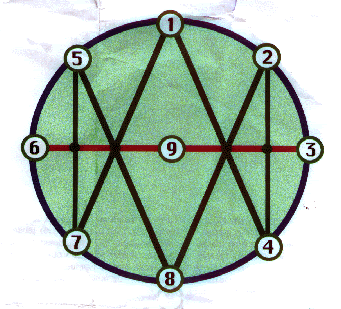
Together these seven Planets with The Written Woman and The Alchemist represent the 9 symbols of the enneagram, though they are a perversion of what they are supposed to be. The Thief doesn't get counted because he is the person searching for enlightenment and the rest are anthropomorphic representations of his self. The Alchemist wears the enneagram (9-pointed star) and Alexander Jodorowsky mentions that each character represents a place on the enneagram in commentary for a deleted scene. I don't know much about this thingy, so here's the wiki quote you were waiting for:

The Enneagram of Personality is mostly taught and understood as a psychospiritual typology (a model of personality types) but is also presented in ways intended to discover and develop higher states of being, essence and enlightenment. Each Enneagram personality type expresses a distinctive and habitual pattern of thinking and emotions. The behavioral characteristics of the personality types are less distinctive. By recognizing their personality pattern a person may be able to use the Enneagram as an effective method for self-understanding and self-development.”
See wikipedia for the nine personality types. The symbol was used by spiritual teacher Gurdjieff who may have learned it from Sufis or Christian monks.


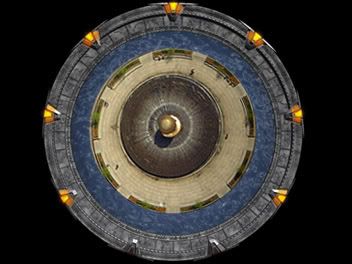
The octagon, highly prized in synchromystic circles for it's connections to star-gates and the center of the Milky Way, and to the Holy Grail, is sometimes referred to as an enneagram (meaning nine) and this is because often times the center of a symbol is a hidden extra point, so an octagon really has a ninth central point. As pointed out by me previously, the “stargate” from the movie Stargate has nine “chevrons,” though only seven are active, and there were nine trees planted around the edge of the fountain sculpture (water-door symbol) which used to sit at the center of the World Trade Center plaza (see this video by Labyrinth of the Psychonaut for more.)


Each Planet is connected to a point on the Enneagram symbol: 1 is Sel/Saturn, 2 is Axon/Neptune, 3 is The Written Woman/Mercury, 4 is Berg/Uranus, 5 is Lut/Pluto, 6 is Isla/Mars, 7 is Fon/Venus, 8 is Klen/Jupiter, and 9 is The Alchemist/Sun. Together they ultimately represent the parts of a person (The Thief), and a connection may be made to the City of the Nine Gates of Hindu mythology where the nine gates represent openings in the body, as well as the Nine Gates to the Kingdom of Shadows which is the fictional nine keys to open the Underworld/Otherworld from the movie The Ninth Gate, as well as the 9 days Odin hung on the world tree, the thrice-three (nine) gates of hell, and so on.


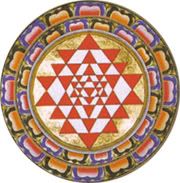
the nine levels of a 3D sri yantra


From Secrets Of The Ninja: "Between these [three centers of power] are nine "gates" up the spinal column that enable the Ninja to collect Qi in the Hara, cultivate it through the breathing techniques, and elevate it to the Mysterious Chamber of the Mind to achieve enlightenment."

In the other series of articles I started in January '09 with Heart Shaped Coffin I noted the interchangeability or rather connectivity of both seven and nine as being the number of layers, gates, domains, etc, and there are also systems which have nine major chakras as opposed to the more common seven. Really, there are thousands of chakras or plexuses that could potentially be mapped out, but seven or nine are the main ones running up the spinal column from the perineum to above the skull. If you're into mind-bending fractal based physics, check out Dan Winter's page on the number nine which resonates with this stuff.


The Great Work is done when the Seven again are One. That's my version of this quote: “It Is Finished When Seven Are One." It represents the idea of bringing the seven planets/metals/traits together into a perfect balance in a single vessel – you (the alchemist/fool/hero).

The group of seven Planets gets together at the Red Tower of The Alchemist. The Alchemist explains: "You have power and money, but you are mortal. You know you cannot escape death. but immortality can be obtained."


He continues speaking during a slide presentation of various holy mountains, "In old traditions they speak of holy mountains. The Meru mountain in India, Mount Kualua of the taoists, Himalaya, Mountain of The Philosophers, the Rosicrucian mountain, the Kabbalistic mountain. There are many holy mountains. The legend is always the same. Nine immortal men live on top of the mountain. From the highest peak they direct our world. They hold the secret to the conquest of death. They are more than forty-thousand years old.” “But they were once like ourselves. If others have succeeded in conquering death, why must we accept it? I know where the immortals live and how to obtain their secret.” He shows them ancient Rosicrucian manuscript which depicts the immortals and shows where they live: The Holy Mountain of Lotus Island.


The Alchemist continues, "We must unite our forces to assault The Holy Mountain and rob it's wise men of the secret of immortality. But to conquor the immortals, we too must become wise men. The elements of chemistry are many but finite. So too are the techniques of enlightenment. With the correct formula, any human being can become enlightened. The immmortals are a group. If we are to succeed, we must cease to be individuals and become a collective being."


The group now enters a yellow room shaped like an eye. The seven Planets and The Thief and The Written Woman and The Alchemist all take their seats around a circular table with a fire pit in the center. "Burn your money" says The Alchemist. They don't seem happy, but the promise of immortality out-weighs their attachment to money/material possessions/life. The Thief had earlier been indoctrinated to the world of money (being paid to take tourist pictures, and working on the animal circus), and now for him money is what makes the world go 'round, so he hides some money up his sleeves. The Alchemist notices: "Thief! If you don't want to die - kill your money!"


"There must be some kind of way out of here, said The Joker to The Theif"


Now the Alchemist says "We shall destroy the self image." Together they burn paper effigies of themselves. The Alchemist: "When the self concept thinks this is I and that is Mine he binds himself, and he forgets the Great Self." The Planets and the rest have become one unit now, but there is still some refining to take place as they journey to Lotus Island and up The Holy Mountain. The journey continues in the final post of this series later...


From The Belly Of The Whale: "As Marcus Aurelius writes, it is one of 'the noblest functions of reason to know whether it is time to walk out of the world or not.' Unknowing and uncertain, the philosopher walks."


Continue with the last post in this series here: The Holy Mountain - Rubedo.

Thursday, June 11, 2009

Purification

This is part 4 of a series: Heart Shaped Coffin, Opening the Stargate, The Journey Back Home, Purification, and Bee Seeing You Through the Veil.


So, I was watching The Abyss recently, the character "Jammer" goes into "a coma" after seeing an underwater alien and hitting his air tank messing up the oxygen and nitrogen mixture. When he wakes up later (by now I forgot he was even in the movie!) he says that he thought he was dead when he "saw that angel." Virgil descends into what is described as a "bottomless pit," an extremely deep area in the ocean, and is taken by other underwater aliens to their movable city where a watery veil passes over him, leaving him in an open-air room he can breathe in. Virgil also thought he was dead (his liquid-oxygen mixture was almost empty), but after a brief "life-review" of his last messages of love to his wife, the aliens bring him and the rest of the crew back to the surface (and may even make the storm on the surface dissipate). At the end, Virgil walks out of a cave like opening and sees his wife again. While watching, I realized that this was not the first "ship" which had a comatose passenger that I had seen in a movie.


In the movie Event Horizon, the character Justin/"Baby Bear" also goes into a coma or similar state after being pulled into the black hole which had opened a portal to hell. The ship, the Event Horizon, had utilized an experimental engine which created and contained black holes to bend space-time and jump the ship great distances. (Fourth dimensional tears in space-time was part of a recent post.)


The ship had jumped with it's original crew into hell, and reappeared 7 years later in orbit around the planet Neptune. The Roman god Neptune was god of the seas and carried a trident which resembles the "Devil's pitchfork," which is also the symbol for the planet. The god is associated with the "line crossing" initiation aboard ships which pass over the equator. Justin entered the black hole to hell but was pulled back out. Because of what he had experienced, Justin attempts suicide by blowing himself out of the airlock. He partially succeeds, but is saved by Captain Miller who is played by Laurence Fishborne, who also plays the captain of the Nebuchadnezzar II hovercraft in The Matrix trilogy.

Speaking of The Matrix, in Matrix Revolutions the character Bane-Smith ("Bane" after "Smith" uploaded his consciousness into Bane) goes into a coma, or similar state, sometime after setting off his ship's EMP bomb and sabotaging their mission. No explanation is given, so I guess he was injured during the resulting chaos. Actually, Bane-Smith is already in a coma at the start of the movie, the events mentioned having already have happened at the end of Matrix Reloaded. Also at the end of Reloaded, Neo stops Sentinal robots with his mind-bullets (well, his innate connection to the Machines due to his artificial consciousness created as part of the Matrix Program) and falls into a coma shortly after. At the beginning of Revolutions, Neo is shown lying head-to-head, or mirror image, compared to Bane-Smith; this reminds me of the Shroud of Turin (Jesus' burial shroud in the tomb), where when unrolled completely, reveals a similar image of Jesus' front and back. Neo is described as being in a coma-like state, though his brainwaves suggest that he is jacked-in to the Matrix. Neo is actually in an in-between world, between the Matrix and Real World, a subway program run by "The Train Man." The artificial subway station is named Mobil Ave, which I've mentioned before is an anagram of "Limbo." Limbo (from Limbus, edge), refers to the "edge of hell," not quite hell, where unbaptized babies and other people who died with original sin go.


At the same time that Neo is on "the edge of hell," Trinity, Morpheus and Seraph are on their way to see the Merovingian to bargain for the release of Neo (the "Train Man" works for the Merovingian). Trinity, the love interest of Neo, has already been at the resurrection of Neo in part 1 of the trilogy where Agent Smith shoots and kills Neo and a kiss from Trinity resurrects him. Having a female character named Trinity hints at the female aspect of the Christian trinity, the Dove or Holy Spirit/Holy Ghost/Spirit of God. The Holy Spirit is the Archangel Gabriel in Islam whose presence is indicated by the character Seraph, short for the Seraphim, the highest choir of angels. Morpheus, the captain of the ship Neo is on, and the name of a god of dreams (The word coma comes from the Greek word "koma" meaning "deep sleep."), hints at the psychological nature of the situation. These symbolic three make their way to Club Hell where the Merovingian is hanging out. They enter through a underground parking garage, then an elevator whose only button is the red Help button with the "p" scratched off, and into the coat check room where they dispatch various bad guys in typical slow motion Matrix action. The Merovingian's programs/bad dudes are programs which have been removed from the matrix program but chose to stay in exile instead of being deleted. Some of them are vampires, and others can walk on walls or do strange stuff - symbolic of demons I believe. The Merovingian, or Merv, is found drinking a martini with green olives. According to IMDB.com, there is a continuity error when Merv eats both of his olives, but a third one miraculously appears back on his toothpick. The toothpick resonates Thoth, as this psychopomp has been connected to teeth in the past by other bloggers. The olives also appear from time to time in Jake's work, and probably among other blogs. The martini glass is hourglass or even worm-hole shaped, resonating the blackhole and stargates. The green olives Merv is eating have red pits, with toothpick through them, may indicate a "Bull's eye" symbol like Saggitarius shooting his arrow into the opposite sign of Taurus and the bull's red eye/red star. These constellations mark the galactic center and anti-center, respectively.


The olives and olive trees are symbolic in Homeric and especially Christian imagery (which may be why it's used in The Matrix). During his Odyssey, Ulysses almost drowns and washes ashore and finally finds rest under an olive tree. Also, there's a olive tree in Ithica where Ulysses ends his journey. The dove Noah sends out comes back with an olive branch. Jesus does some preaching on the Mount of Olives, and is below the mount in the Garden of Gethsemane the night before his crucifixion. Gethsemane means "oil press," and is also where the Virgin Mary is buried according to the Eastern Orthodox Church. The name of "oil press" probably refers to the production of olive oil which was quite the luxury back in the day.


The olive tree shows up in psychological horror movie Sublime in the backyard of a man who winds up in a permanent vegetative state, which is a type of coma. George Grieves celebrates his 40th birthday and prepares for his colonoscopy the following day (the 23rd of the month). The night of his birthday he waters his dying olive tree and then goes in the house where he and his friends pose for a Last Supper style picture, George taking the place of Jesus, of course. A nurse, Zoe, befriends him in the hospital and she and he have sex at one point where she mounts him facing away, revealing a olive tree tattoo on her back (seen on above poster). The tree has bare branches and Zoe explains that it is the Tree of Life waiting for spring.

The crucifixion is observed around Easter time which is the first full moon on or after the spring/vernal equinox. Spring is symbolic of the suns return (resurrection) to the northern hemisphere when the days become longer than the nights. The date changes every year, but traditionally the 22nd of March is the vernal equinox, George's birthday is also on the 22nd. For his birthday, George's wife gives him a new olive tree from the Garden of Gethsemane at the Mount of Olives which is a disease resistant variety ("immortal," or at least a better version of his tree).

The whole movie flips back and forth between George's experience in the hospital, which is a "dream" he's having while in his coma, and flashbacks of the day of his birthday. He is on "the edge" between life and death, and must learn at the end to let go and fall. The movie opens with George dreaming of falling and waking just before he hits the ground. His wife reminds him of the Old Wive's Tale that if you hit the ground in a dream - you die in real life. Reminds me of The Matrix when Neo fails to make the leap of faith in the matrix simulation, he hits the street and actually bleeds in real life. Just before the end of the movie, George is tortured by a male nurse who represents fear and who speaks to George before he starts to cut him up: "Ready for a little lesson? To be set free?" "A dose of reality." "Now you're gonna face your fear and you wont be afraid no more. I'm gonna set you free." The hospital which George is stuck in is named Mount Abaddon. Abaddon (also, Apollyon, Appolyon and Appolion) is the Hebrew name of the demon identified as the angel of the bottomless pit, or the abyss (I hope you didn't forget the first movie I mentioned already!); in Revelation 9:11, Abaddon ties up the Devil for a millennium. After his torture, the male nurse calls George heroic, and tells him that now he can do anything. George's last act is to throw himself from his 7th floor window (room 721, 7(7+7+7)) and hits the ground. Back in reality, George's monitors flatline and he closes his eyes, confirming the statement at the beginning of the film that if you hit bottom in a dream, you die in real life.

I started talking about movies where people were comatose on a ship of some sort, which I felt added another level to the symbolism, but there are many more movies featuring temporary coma-like or unconscious states, such as Kill Bill, Face Off, and The Bourne Identity where Jason Bourne is unconscious on a fishing boat after being shot and presumed dead. There's even at least one movie titled Coma.


While thinking about comatose people on ships I remembered the story of Jonah and the Whale. Actually I had not read the story, all I knew was that Jonah somehow ended up in the belly of a whale. God commanded Jonah to warn the city Ninevah that they were to be destroyed by God, but instead of doing his mission Jonah skipped town on a boat. The boat became caught up in a storm which would not dissipate until Jonah got off. As soon as Jonah is thrown off the ship he was swallowed by a whale. The words which have been translated as "whale" simply mean "a great aquatic animal." He spends 3 days and nights in the belly of the whale until he is regurgitated on the shore back at home. So, Jonah eventually did his duity and told the citizens of Ninevah that they would be destroyed in 40 days, and the citizens spent that time praying and repenting. At the end of the allotted time, God changed his mind and let them live (Yeah, I know, it's strange that Old-Testament-God doesn't commit genocide!). And thus, Jonah actually converted, "saved," an entire city at once.


Jonah on left, Jason in upper right,
and 2 pics of Dagon/Oannes


Wikipedia notes a connection to another sea adventure by another hero with a "J" name, that of Jason and the Argonauts: "The story of the hero Jason in Greek mythology shares several similarities with the story of Jonah which have been noted by Joseph Campbell and more recent authors such as Gildas Hamel. Drawing on the Book of Jonah and Greco-Roman sources — including Greek vases and the accounts of Apollonius of Rhodes, Valerius Flaccus and Orphic Argonautica — Hamel identifies a number of shared motifs, including the names of the heroes, the presence of a dove, the idea of "fleeing" like the wind and causing a storm, the attitude of the sailors, the presence of a sea-monster or dragon threatening the hero or swallowing him [...]. The Greek rendering of the name Jonah was Jonas, which differs from Jason only in the order of sounds —both os are omegas." The letter omega is symbolic of death and an ending, "I AM the alpha and the omega, the beginning and the end."


Jonah in a symbolic maze/labyrinth


Another "J" named person who symbolically goes through the same thing is Joseph of Arimathea who incurs the envy of his brothers after his father Jacob gives him the coat of many colors. When Joseph was 17, his brothers plotted to kill him, except the oldest brother Reuben who secretly plans to save Joseph. The plot is to toss Joseph into a pit (symbolic Abaddon) and claim that an "evil beast devoured him" (symbolic sea-beast). Joseph is instead sold to passers-by for 20 pieces of silver. The brother's dipped his coat into goats blood and told their father that Joseph had been torn apart by wild beasts.


I thought the above picture of a beached Basking Shark at Hells Mouth Beach resonated with Jonah's whale. Looking for pictures of Jonah on the Whale, I realized what a resonance the whale mouth had with the Hellmouth, or gateway/portal to hell. (Scroll up, and check out those three small pictures for Event Horizon, doesn't the door to the blackhole machine look like a Hellmouth?) The Hellmouth is what Buffy guards in Sunnydale California in the Buffy television series. The name Sunnydale could conceivably mean Sunnyvale as in a "sunny valley," as the word "-dale" refers to a valley. And if this is the case, then Sunny-vale might really be Sunny-veil. But I digress...


take note of the dove above the tower


And perhaps the best known "J" named person who undergoes a similar symbolic death and resurrection is Jesus. Also sold out for silver (30 pieces, with inflation), he was arrested by the "Temple Guards" (Knights Templar?) in the Garden of Gethsemane at the foot of the Mount of Olives. He was crucified, died, and was buried. His body was turned over to previously mentioned Joseph of Arimathea, who put it in his own rock hewn tomb.


Jesus "descended into hell," according to the Catholic prayer known as the Apostles' Creed. On the third day, like Jonah, he rose from the cave/tomb/hell/pit of abaddon/abyss/whale-belly. What did Jesus do for those three days? Well he was saving souls in Hell, of course. Like the trinity of characters including Trinity in The Matrix who battled the Merovingians demons and "beat" the Merovingian/Devil in club Hell while Neo was in Mobil/Limbo, Jesus spread the word of God to those who came before him who awaited the Redeemer. "Christ went down into the depths of death so that 'the dead will hear the voice of the Son of God, and those who hear will live.' Jesus, 'the Author of life', by dying destroyed 'him who has the power of death, that is, the devil, and [delivered] all those who through fear of death were subject to lifelong bondage.' Henceforth the risen Christ holds 'the keys of Death and Hades', so that at the name of Jesus every knee should bow, in heaven and on earth and under the earth.'" (- Vatican website) Upon his resurrection, and after 40 days of hanging out with his friends, Jesus ascended to heaven from the Mount of Olives (Acts 1:9-12). When he returns, it will be at the Mount of Olives (Acts 1:11 and Zechariah 14:4).


what hope do we have if even jesus goes to hell when he dies?


When Jesus is on the cross, one of the last things he says is "I thirst" (John 19:28). According to popular translation, a spear with a sponge attached was dipped in vinegar and lifted to Jesus' lips. In The Jesus Conspiracy, authors Holger Kersten and Elmar Gruber note that an error of translation was made when the word hyssos, "short spear," was taken for hyssopos, "hyssop." The hyssop plant is mentioned several times in the Old Testament as it was used to spread the lambs blood around the door frame for passover, as well as other sacrificial or purification ceremonies. The hyssop mentioned at the crucifixion may have been another plant species, different from the hyssop of today, or may have just been a stick or branch of whatever plant was nearby. It is theorized by William Henry in Blue Apples that the hyssop used was of a narcotic variety and put Jesus into a catatonic state. Other theories also have postulated that Jesus only looked dead when he was removed from the cross, being in a unconscious state, he was revived later and lived a long happy life with Mary Magdalane, etc.

Strangely enough, there is a true to life version of Jonah and the Whale:
Real Life Jonah: In February, 1891, the ship Star of the East was off the Falkland Islands when the crew spotted an 80' sperm whale. Two rowboats filled with crewmen were launched to capture the monster. Closing in, one harpooner let go his weapon and shafted the whale, which lashed out, almost overturning the boats. Returning to the ship with their dead whale, the crewmen realized one sailor, James Bartley, was missing. It was decided he had been tossed overboard in the fight and had drowned.

Six hours later the crewmen began removing the blubber from the dead beast. By midnight the task was still unfinished, and the sailors went to bed. In the morning, they resumed their job. Then the unexpected happened. According to M. de Parville, editor of the Journal des Debats, writing in Paris in 1914, "Suddenly the sailors were startled by something in the stomach which gave spasmodic signs of life. Inside was found the missing sailor, James Bartley, doubled up and unconscious. He was placed on deck and treated to a bath of sea-water which soon revived him, but his mind was not clear and he was placed in the captain's quarters." Recovering, Bartley recalled being hit by the whale's tail and that he had been "encompassed by great darkness, and he felt he was slipping along a smooth passage that seemed to move and carry him forward. His hands came in contact with a yielding, slimy substance, which seemed to shrink from his touch. He could easily breathe, but the heat was terrible. It seemed to open the pores of his skin and draw out his vitality. The next he remembered he was in the captain's cabin."

Except for the fact that his face, neck, hands had been bleached white, Bartley--like Jonah--survived the belly of the monster.
The heat and sucking out of moisture that this man suffered reminds me of Jesus being thirsty, and may indicate the stage of Purification in alchemy, sometimes symbolized by a furnace or sweat bath drawing the soul and spirit out of a body like steam. The three images from Rosarium Philosophorum represent: Extraction of the soul, or impregnation: "Here, king and queen lie dead / The soul departs in great haste. Here, the four elements separate / And from the body the soul departs apace.", Washing or Purification: "Here, the dew falls from the sky / And washes the black body in the grave.", and Jubiliation of the soul, or Birth, or Sublimation: "Here, he soul floats down / And refreshes the purified corpse."

"But the philosophers have described this 'spirit' and this 'soul' as 'steam' (...), and as there is moisture and dryness in man, our work is nothing but steam and water." (Turba philosophorum, Berlin, 1931)
I just had a funny memory while typing the above quote, it is of an old episode of the Batman television series (with Adam West). The Joker (or Penguin, maybe) made a gun which zapped all the liquid out of a persons body and left a pile of dust in place of what had once been a person.


The last thing Jesus said was, "Father, into your hands I commit my spirit!" (Luke 23:46). Jonah/Ionas means "Dove," and the dove represents the Holy Spirit in the Christian Trinity. The Spirit/Dove entered Jesus at his baptism and at the crucifixion descended into the underworld for 3 days and returned (re-entered Jesus' body) at the resurrection. Jonah (Dove/Holy Spirit) left the world for 3 days (as a coward running from God's will), but after his time in the whale (cave/tomb/pit/grave) he returns as the great prophet and converts an entire city. In my alchemy book, the definition of dove is: "a symbol of renewed spirit or infusion of energy from Above. Chemically, it signifies the change from the Black Phase to the White Phase." (White, like the poor man trapped in the whale who came out with bleached skin?!)


The seventh operation of Alchemy, Coagulation, is seen the in purple area of the Azoth picture. From Sorcerer's Stone, by Dennis William Hauck:
The final, seventh circle shows an androgynous youth emerging from an open grave, with the Latin word Lapidem, meaning "the Stone," on the outer ring next to it. This is the operation of coagulation, in which the fermented child of the conjunction is fused with the sublimated spiritual presence released during distillation. The resurrection of the soul is accomplished by bringing together only the purest essences of one's body and soul into the light of meditation. In other words, coagulation incarnates and releases the purified soul that the Emerald Tablet described as the "Glory of the Whole Universe." At this stage, the alchemists are working with the "new" or resurrected Salt.(Body)


For more wisdom from the depths, check out the now discontinued blog, From the Belly of the Whale.

UPDATE: Also check out these posts which synch with this one: RED ROWEN DUN DA VALE by Aferrismoon, and Sea Serpents by Quinta Essentia. Also, A Burning Ring of Fire IV by Celtic Rebel synched a bit (see my comments there for more).

For anyone following my ramblings on the New Age religion and the Pope, it might interest you to know that in the St. Malachy prophecy which numbered #111 popes and gave each a nickname: the name of #111, the current and last pope Benedict XVI (Joseph Ratzinger), is: "The Glory of the Olive." From crystalinks.com: "The Order of St. Benedict has said this Pope will come from their order. It is interesting that Jesus gave his apocalyptic prophecy about the end of time from the Mount of Olives. This Pope will reign during the beginning of the tribulation Jesus spoke of. Saint Benedict himself prophesied that before the end of the world his Order, known also as the Olivetans, will triumphantly lead the Catholic Church in its fight against evil."


The song which plays during the credits of Matrix Revolutions quotes passages from the Upanishads:
"Lead us from darkness to the light,
Lead us from knowledge of the unreal to the real,
Lead us from fear of death to knowledge of our immortality.
Peace, peace, peace."


This series continues with Bee Seeing You Through the Veil.

Psychopomps

What are you saving up to be.. Jewish?